
An automated trend-to-content pipeline needs to do two things well: know what's rising, and know who it's rising for. Matt Lakajev's July 2026 LinkedIn case proves why both matter. He wrote nine posts for a client in two weeks — five went viral, one hit 1,602 reactions, 90 comments, and 23 reposts, the client's highest-engagement post ever after years of posting. His explanation wasn't "post more." It was that LinkedIn, Meta, and TikTok have all quietly rewired their feeds to route content by tribe — shared identity, shared grievance, shared vocabulary — instead of follower count or job title. The content that wins now is tuned to a specific group of people who already recognize themselves in it.
That's a big claim to build a business on: know exactly which trend is rising, for which audience, right now — and get something written before the moment passes. Most teams can't do both halves at once. You either watch trends manually (slow, and you miss the ones that peak overnight) or you generate content on demand with a general-purpose AI writer that has no idea what's actually rising or who it's rising for. This is the gap an automated trend-to-content pipeline is built to close — and it's exactly the problem we built PulseFlow to solve.
The frustration compounds as the velocity of trends accelerates—what used to be a weekly cycle now shifts daily.
Why most trend-to-content workflows are broken — and why you probably feel it
The typical content team stitches together a fragile stack: a Google Alerts keyword, a manual subreddit scan each morning, a Slack channel where someone shouts "this is trending," and a ChatGPT session to draft a post. There's no integration — trend-spotting happens in one tool, writing in another, approval in a third, with hours spent on that coordination before a word of the actual piece exists.
The real-world pain is sharper than inefficiency. A team spots a rising conversation about WebAssembly on a Tuesday morning. By the time they've gathered sources, debated angles, and produced a draft, it's Thursday. The conversation has peaked, and the article lands as a delayed echo rather than a leading voice. Or they use a generic AI writer that produces a grammatical 1,500-word piece with zero sense of current momentum — it reads like something written in a vacuum, for no one in particular.
We've seen teams try to fix this with point solutions: a trend-monitoring service, an SEO tool for the keyword, a Claude chat for the outline, then manual reformatting for LinkedIn versus Medium versus their own blog. Each tool adds overhead, and the gap between "we spotted a signal" and "the content is published" still stretches to hours or days. The bottleneck isn't a lack of tools; it's that the tools don't talk to each other.
Some teams bridge the gap with no-code platforms like Make.com, chaining triggers and API calls to auto-post across channels. It's clever, but still needs a human to pick the topic and handle failures — the integration improves, but the maintenance burden becomes the new bottleneck.
This gap forces teams to be reactive. Instead of leading a conversation, you're always publishing a beat behind — and Lakajev's numbers are the sharpest evidence of what's actually at stake: his client didn't post more often than competitors. Each post was built for one specific, already-existing group of people, which a generic AI writer — or a human working from a stale trend report — cannot do on a two-day delay.
Most tools solve only half the equation: a trend alert without the tuned content, or endless content with no awareness of what's rising or who it's for. The two halves never talk to each other. That's the bottleneck we built PulseFlow to solve.
But what if you could close that gap entirely — with a pipeline that scans, scores, and writes for you, automatically, without losing the human judgment that decides who a piece is really for?
How an automated trend-to-content pipeline actually works: PulseWatcher → PulseFactory → PulseRanker
Most people assume an AI content pipeline is either "just a scraper that collects links" or "just a rewriter that paraphrases articles." Neither captures how a real system integrates monitoring, drafting, and quality control into one autonomous workflow. At PulseFlow, we've built exactly that — and to prove it, this article was produced by that same pipeline before we reviewed it.
PulseWatcher: The radar tower
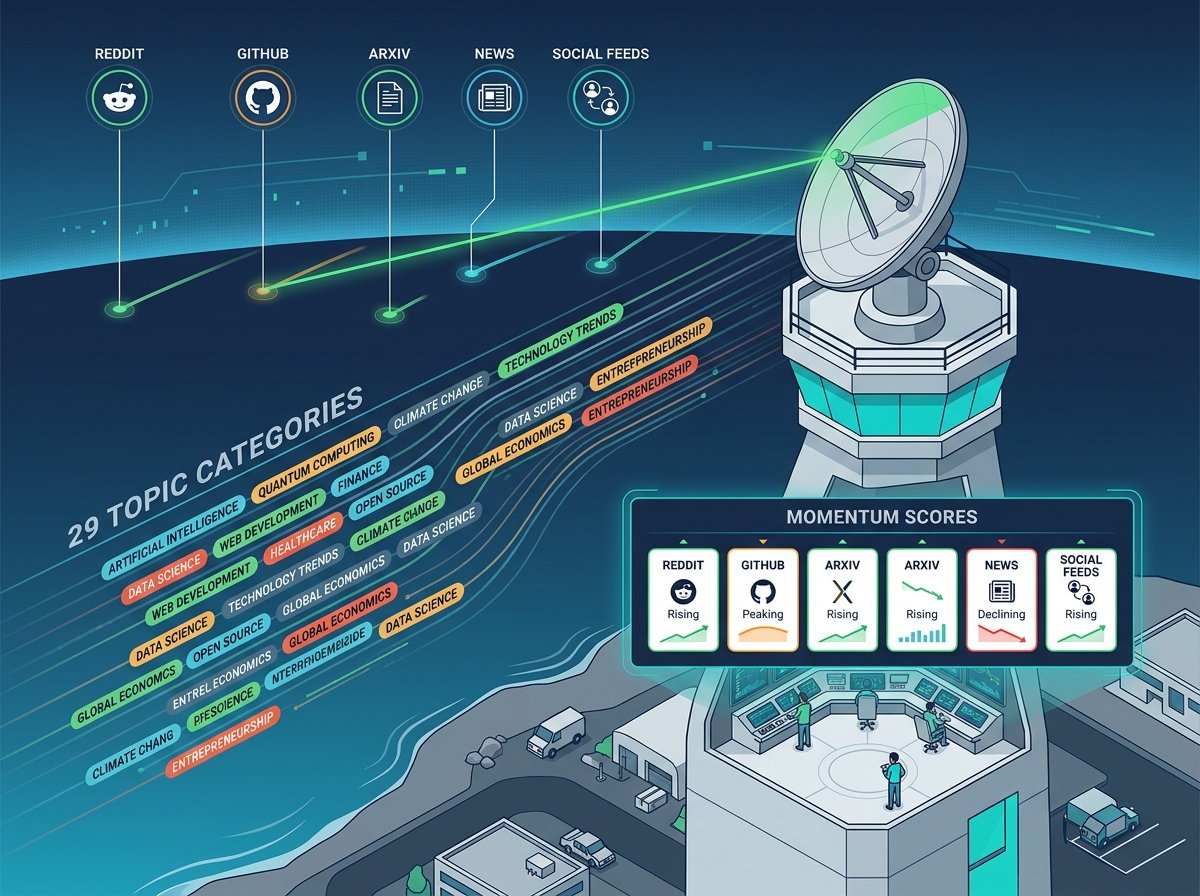
PulseWatcher runs continuously, scanning curated topics across Reddit, GitHub, arXiv, news, and social feeds every two hours. It doesn't just collect links — it scores each signal for momentum. Rising? Peaking? Declining? That tells you not just what people are talking about, but whether the conversation is still accelerating. Think of it as a radar tower: it spots every plane on the horizon, but flags only the ones approaching fast — the same triage logic that separates a signal worth building a post around from noise.
The scoring combines frequency of mentions, velocity of new threads, and cross-source correlation. When "agentic AI" simultaneously spikes on Hacker News, GitHub sees a flurry of new stars, and Reddit's r/MachineLearning has multiple front-page threads — that's a rising signal with high confidence. Only rising signals surface to the dashboard, so your team never wastes time on topics that already topped out.
Reddit in particular has become a goldmine for conversational search phrases traditional keyword tools miss. As FilmDaily noted, Reddit functions as an unfiltered source for long-tail keyword gold — real questions and pain points that surface when people talk to each other rather than search in a vacuum. A 2026 Inc. analysis found that AI models now rely on Reddit more than brand websites for reputation signals — a sharper claim than "Reddit is popular": the platforms deciding what gets surfaced already weight it more heavily than official brand content. PulseWatcher indexes those conversations in near real-time, so you capture the exact language your audience uses before it becomes a keyword trend.
PulseFactory: The assembly line

When you click a validated trend — say, a surge around "agentic AI" on Hacker News — PulseFactory triggers a deep research pass. It gathers sources, identifies competitor gaps, and extracts key angles — parsing the top relevant articles and discussion threads for claims, counterclaims, and evidence, then flagging what's missing: the gap your article can fill.
Next, it drafts a complete article: introduction, multiple H2 sections, cited evidence, conclusion — in a tone aligned with your PulseBrief (your brand's voice profile), whether casual for a blog or authoritative for Medium. It does this in minutes, not hours, and can produce versions in nine languages from the same validated signal, preserving tone and structure across all of them.
The draft doesn't stop at a first pass. PulseFactory runs its own editorial critique on every draft — checking facts, sources, tone, and structure — and sends the piece back for revision until it clears a quality bar. Only then does it reach a human's review queue — the same gate this article went through. Several automated revision passes ran before a human ever saw it; the human's job at that point isn't to rewrite it, it's to decide whether it's ready to publish (more on that below).
A developer on DEV Community shared building an article pipeline with Claude Code in half a day — but noted it still needed heavy editing since it lacked a dedicated research step. PulseFactory's deep research pass is what sets it apart: it synthesizes multiple sources and builds a fresh argument, rather than rewriting one.
PulseRanker: what we're building next
Here's the honest version of the roadmap: PulseWatcher and PulseFactory — the engines described above — are live today; this article is proof of that. PulseRanker, the third engine, is what we're building next: a feedback loop that watches how published articles actually perform and feeds that back into which trends and angles PulseFactory prioritizes next time. Today that loop is manual — a human decides what worked. PulseRanker is how we plan to close it automatically. We'd rather tell you exactly where we are than describe a finished system that isn't built yet.
A team can go from "there's a trend" to "here's a publishable, critiqued draft" in minutes, not days. The human's job shifts from manual creation to strategic curation: deciding which trend to pursue, which audience it's for, and adding the polish that makes content resonate with that specific group.
With all that automation, you might wonder: where's the human? Here's the honest answer — and why it's actually your competitive edge.
Why we keep a human in the loop — and why that's your competitive edge
Here's the belief most content-automation pitches lean on: full autonomy is the goal, no human touch, maximum scale, publish everything on autopilot. It sounds seductive — more posts, more shots on goal.
The evidence says otherwise. A 2026 analysis from Wowbix warns that "fully automated content pipelines with no editorial oversight" are losing favor, producing generic, low-trust content that algorithms increasingly penalize. Even Trustypost's n8n template stops at auto-drafting — it requires human approval before anything goes live. And Lakajev's numbers make the sharpest version of the case: his client didn't publish more content than competitors. He published nine posts tuned to one audience's exact grievances and vocabulary, and five converted into the client's best results ever. The lever wasn't volume — it was fit, and fit is a human judgment call an algorithm can't make alone, because it requires knowing exactly who a piece is for and what they already believe about themselves.

Keeping a human in the loop isn't a limitation to apologize for — it's a deliberate design choice that protects what automation cannot: brand fit, timing, and audience judgment. A human review gate catches: Is this topic still relevant to our audience? Is it appropriate to post today given current events? Does this tone match our LinkedIn voice, or does it sound too promotional for Reddit? These require context and intuition no model fully replicates. This article is a real example: PulseFactory's own critique loop pushed this draft through several revisions against its quality bar — no human rewrote a word of it. What a human did do, before you ever saw this page, was read the finished draft and decide it was ready to publish — exactly the review gate this section is arguing for.
Consider the Twitter/X landscape in mid-2026: posting a hot take during a global crisis can backfire spectacularly. A fully automated system wouldn't know the topic it's about to publish intersects with a sensitive event. A human reviewer checks a simple calendar of holidays, industry events, and known sensitivity periods before approving. PulseFlow also lets you maintain a PulseBrief per brand, with guardrails like "never joke about security breaches" or "avoid superlatives about competitors." Only a human applies judgment calls like those consistently, every time.
Counterargument: "If you still need a human to review, why not just write from scratch? Doesn't this defeat the purpose of automation?"
Resolution: The human doesn't start from zero. They start from a completed, critiqued draft that's already researched and cited — the equivalent of Lakajev's process at the point where the AI Second Brain has already produced a draft, and the only job left is deciding whether this specific piece lands with this specific audience. Reviewing a draft like that takes a fraction of the time writing one from scratch would. Automation handles research, drafting, formatting, fact-checking, and revision; the human adds the audience judgment and timing calls that make content trustworthy and distinctive.
We're early — PulseFlow is in private early access, so we don't have customer case studies to point to yet. The honest version of that is the more interesting story: this article is the case study. It went from a raw trend signal to a critiqued, revised draft entirely inside PulseWatcher and PulseFactory's automated loop, then through the same human publish-decision gate described above — nobody rewrote a sentence, and the quality-score badge on this page is the same one that gate looked at. That's the whole pipeline, working exactly as designed, on the article you just read.
If you want to be one of the first teams we point to next time, join our early-access waitlist below and help us build that portfolio for real.