
The Microsoft Teams call that moved $2.3 million
At 4:15 PM on Friday, July 24, 2026, CFO David Chen watched his CEO's familiar face fill the Microsoft Teams screen to authorize three urgent vendor transfers totaling $2.3 million before the quarterly audit closed. A real-time deepfake of the CEO on Microsoft Teams moved three vendor transfers totaling $2.3 million before anyone suspected the voice — and it was built from less than a minute of public audio, sparking the creation of a definitive 2026 deepfake compliance playbook.

The call executed every psychological lever perfectly. The CEO's voice carried its usual slight rasp, his characteristic hand gestures matched every prior quarterly review, and his apology for the late-Friday interruption was entirely convincing. It was the exact type of high-stakes, low-friction request that bypasses standard friction points in corporate finance.
The transfers cleared instantly through the payment portal without a moment of suspicion from the finance desk. The digital authorization logs showed normal executive routing, and the network traffic originated from a trusted residential IP block. It was a flawless execution of generative-AI social engineering, completely circumventing traditional network security controls by hacking the human trust layer instead.
The Discovery in the Memo Line
The fraud went completely undetected by the enterprise's automated security perimeter. It took an observant staff accountant, reconciling the daily batch files at 9:00 AM on Monday, to notice a procedural anomaly. All three outgoing wire transfers contained the exact same memo line: "vendor settlement."
The CEO never used that specific phrasing for quarterly vendor true-ups. A quick, out-of-band text message to the real CEO's personal device confirmed the worst: he had been on a flight to London during the exact window the Teams call took place. The 2026 engagement iSECTECH — CEO Deepfake Fraud in 2026 documents how the attackers harvested just 48 seconds of the CEO's voice from a recent podcast appearance to train the real-time conversion model. The attackers didn't just clone his voice; they mapped his digital behavioral footprint. By scraping recent YouTube keynote addresses and earnings call webcasts, the generative model learned not just the pitch and timber, but the specific cadence, the habitual pauses, and the exact way he cleared his throat when discussing large financial sums.
This incident is not an isolated anomaly; it is the mathematical reality of modern cybercrime. The FBI's numbers provide the grim backdrop for this escalation, putting AI-related scam losses at $893M in 2025. Voice cloning serves as the primary psychological lever that makes seasoned executives bypass secondary verification.
Furthermore, Microsoft's Digital Defense Report flags generative-AI social engineering as a fastest-growing criminal category globally. Attackers are no longer wasting weeks trying to breach hardened payment gateways. They are spending hours generating synthetic executives to simply ask for the money directly, achieving a radically higher return on investment for their criminal syndicates.
The Regulatory Clock Was Already Running
The financial loss was only the beginning of the organization's crisis. Modern compliance frameworks no longer treat deepfake incidents as simple fraud; they treat them as regulated synthetic media events with strict statutory timelines. By the time the compliance team mobilized on Monday morning, the company was already losing a regulatory race against two overlapping jurisdictions.

The federal TAKE IT DOWN Act platform duties took effect May 19, 2026, fundamentally altering the liability landscape for any organization hosting, transmitting, or processing user-generated or synthetic media. The legislation imposes severe penalties of $53,088 per violation. Crucially, the act contains no small-business or nonprofit exemption, meaning mid-market enterprises carry the exact same compliance burden as hyperscale social networks. Furthermore, this statutory penalty is not a flat, one-time fee; it compounds per violation. This means every individual synthetic asset hosted, shared, or processed across the network constitutes a distinct liability event. For a company handling thousands of vendor interactions and internal communications monthly, a single compromised communication channel could theoretically generate millions in regulatory fines before the IT department even wakes up.
Simultaneously, the European Union's regulatory apparatus was bearing down on the incident. The EU AI Act's Article 50 transparency and labeling rules become fully enforceable on August 2, 2026. These rules mandate immediate, machine-readable labeling of any synthetic media interacting with EU citizens, regardless of whether the media was generated for fraud, entertainment, or corporate communication.
The company had hosted the synthetic video file on its internal servers and processed the associated audio through its European subsidiary's compliance archiving system. By the time anyone inside the company actually uttered the word "deepfake," the organization was facing massive statutory fines if they failed to properly document, label, and report the incident. The call ends, the money moves, and then the part every compliance officer fears: the fraud is discovered not by the detection tool, but by an accountant checking the memo line.
Why the detector didn't catch it — and why that doesn't exempt you
The legal duty runs on a strictly enforced 48-hour clock, not on a detection confidence score.
Automated deepfake detection cannot be the primary compliance control in 2026 — ImageCLEF's winning adversarial generator evaded 90% of organizer detectors while the best audio detector left an 11.25% false-positive gap. When the frantic compliance team finally isolated the recorded CEO video and ran it through their enterprise-grade detection tool, the verdict came back definitively "authentic."
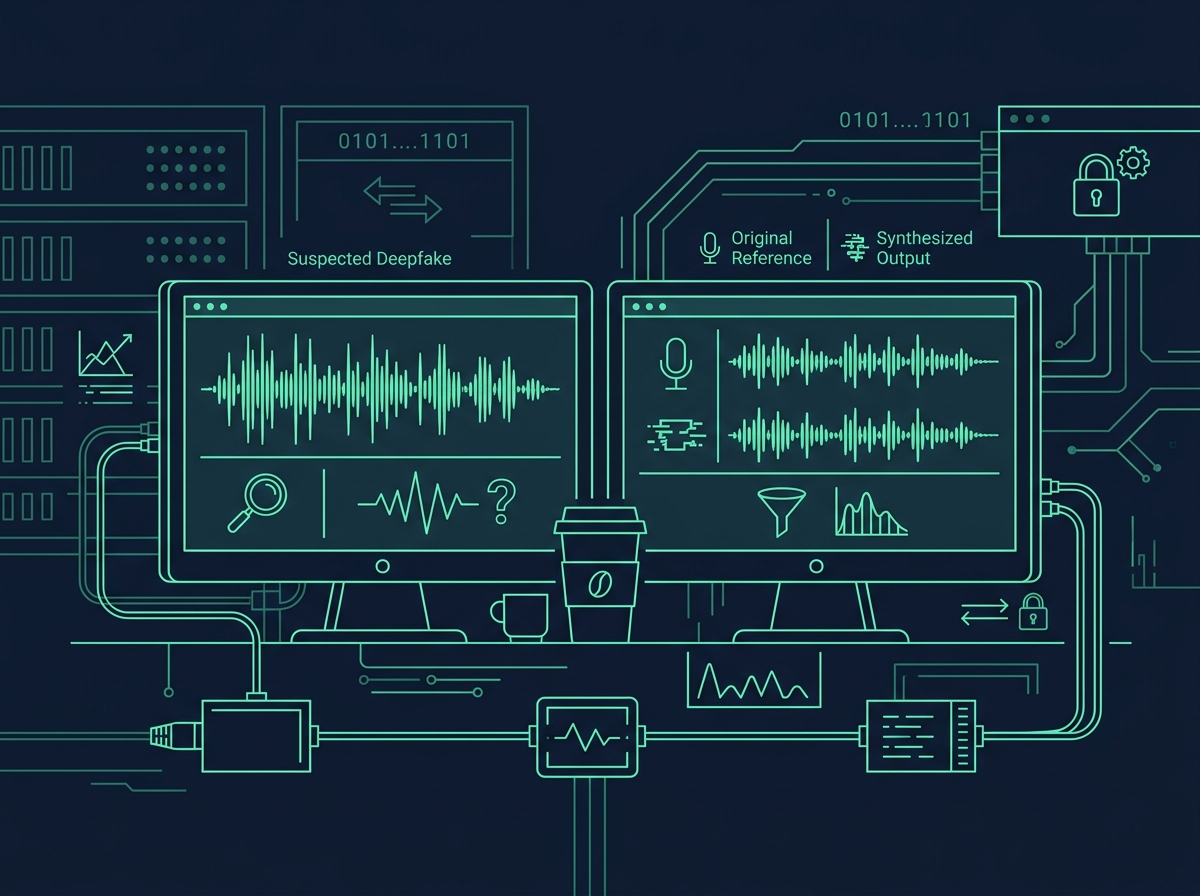
Desperate for a different answer, the team immediately licensed a secondary, highly-rated commercial detection API. That tool also agreed completely, scoring the malicious Teams call with a 98% confidence rating for human authenticity. The clean verdict was not a glitch; it was the intended result. The deepfake was adversarially built to evade exactly this kind of algorithmic scrutiny.
Adversarial Generators Defeat Triage Tools
Detection systems fail because modern synthetic media is engineered specifically to exploit their mathematical boundaries. Threat actors no longer rely on raw generative output. Instead, they pipe their synthetic media through adversarial refinement networks that actively remove the artifact traces that commercial detectors look for.
In ImageCLEF 2026, the winning image generator evaded 90% of organizer detectors and the top audio generator evaded 61.4% of participant detectors. The winning adversarial generator utilized FLUX.1-dev combined with PuLID and a Projected Gradient Descent (PGD) attack targeting 12 distinct detectors simultaneously, as detailed in the Adversarial Deepfake Generation and an Investigation of Purification-Based Adversarial Detection paper.
This specific PGD attack works by introducing mathematically calculated, yet humanly imperceptible, perturbations directly into the media file. To the human ear and eye on a compressed enterprise video stream, these micro-changes are entirely invisible. But to the detection algorithm's neural network, they completely scramble the decision boundaries, forcing the security tool to classify a fully synthetic generation as a highly authentic, unmodified recording. This means that attackers are downloading the exact same detection tools that compliance teams purchase. They use these tools as local fitness functions, iteratively adjusting the deepfake's pixel and audio data until the detector gives it a passing grade. By the time the synthetic media hits a corporate Teams call, it is mathematically guaranteed to bypass standard defensive screens.
The 11.25% False-Positive Trap
Benchmarking data further dismantles the illusion of perfect technical defense. On the audio detection side, the best audio ensemble—utilizing four self-supervised backbones—scored 0.9522 on the official ImageCLEF evaluation. However, this high score masked a critical operational flaw: it left an 11.25% false-positive gap on authentic audio recordings.

The RADAR Challenge 2026 findings confirm that this detection score collapses even further under routine production conditions. When subjected to standard Teams or Zoom compression, resampling, background noise, and multilingual environments, the detectors degrade sharply. A typical corporate network environment is a literal nightmare for maintaining pure audio baselines. Executives routinely take calls from busy airport lounges, utilize low-quality Bluetooth headsets, and suffer from intermittent packet loss on residential Wi-Fi networks. Every single one of these routine signal degradations structurally mimics the exact same digital artifacts that automated deepfake detectors are trained to flag.
For a corporate compliance team, an 11.25% false-positive rate is catastrophic. If an enterprise automated security system flags one out of every ten legitimate CEO communications as a deepfake, the business grinds to a halt. The compliance team cannot legally block authentic executive wire authorizations without incurring massive operational damage, making aggressive detection thresholds practically unusable in a live corporate environment. When a compliance officer is forced to choose between halting a legitimate, time-sensitive merger because of a false positive, or manually overriding the security detector, corporate human nature dictates they will override the warning—which is exactly the behavioral loophole the attackers are counting on.
Why the Counterargument Fails in Production
A skeptic would say: one benchmark's adversarial generator beating evaluation detectors doesn't prove detection is useless in production. Real-world fraudsters aren't optimizing against twelve detectors simultaneously, and a 0.9522 ensemble score is still strong; telling firms not to rely on detection tools they're required to use is reckless.
This objection fundamentally misunderstands the asymmetric nature of targeted wire fraud. The attacker does not need to build a generalized model that fools every detector on earth. They only need a single uncaught request to succeed. The CFO's Friday afternoon call is the definitive counterexample. The threat actor mapped the enterprise's specific vendor ecosystem, identified the exact triage tools in use, and optimized the payload solely for that specific environment.
Furthermore, relying on a 0.9522 detection score ignores the legal reality of 2026. The legal duty runs on a strictly enforced 48-hour clock, not on a detection confidence score. The TAKE IT DOWN Act and Brooke's Law in Florida demand concrete administrative action regardless of what a commercial detector outputs. Article 50 requires transparency labeling with no deception intent needed; if it is AI-generated, it must be labeled, even if your detector gives it a pass.
The Workflow Pivot to Legal Clocks
The rejected alternative was doubling down on automated detection as the primary control. The IT department initially proposed buying a more expensive, aggressive detection suite. The compliance team realized this was a trap: they would be purchasing the exact same detectors that adversaries were already reading about, testing against, and optimizing around in open-source repositories.
This leads to the counterintuitive reality of 2026 synthetic media compliance: perfecting your deepfake detection actually increases your enterprise risk. Organizations that trust their detectors implicitly will miss the adversarial fakes, fail to initiate their statutory incident response, and let the 48-hour legal clock expire. A clean detection verdict provides a false sense of compliance while the regulatory penalties compound.
Instead, the team stopped betting on perfect detection. They built an evidence-preservation and takedown workflow instead. They relegated detectors to the role of initial triage, while relying on provenance metadata, forensic chain-of-custody, and rigid incident-response timelines to carry the actual legal weight. Once the team stopped betting on perfect detection, the real question became: what does a defensible 48-hour response actually look like when the content is already live?
The 48-hour response that built the 2026 deepfake compliance playbook
The compliance win came from a 48-hour takedown and evidence preservation, not from detection — the platform removed the cloned video inside the TAKE IT DOWN clock, avoiding the $53,088-per-violation penalty, and the same workflow generalizes through a takedown-clock decision tree. Recognizing that the technical perimeter had failed, the team pivoted instantly to legal execution.

What happened next became the blueprint for the organization's entire compliance posture. The threat actors had initially hosted the cloned CEO training data on a popular User-Generated Content (UGC) platform before piping it into the live Teams call. The company's legal counsel immediately drafted and issued a formal 48-hour takedown notice under the TAKE IT DOWN Act to that hosting platform.
Because the notice was perfectly formatted and delivered within hours of discovery, the UGC platform removed the offending video inside the statutory clock. This rapid execution shielded the enterprise. There was no $53,088 penalty levied, and no FTC warning letter arrived in the mail. The organization successfully contained the regulatory blast radius by respecting the clock rather than arguing with the algorithm. This decisive action also protected the company from secondary exposure under the DEFIANCE Act, which governs civil liability for deepfake distribution. Preserving evidence for this litigation requires more than just taking a desktop screenshot of a Teams interface. It demands capturing a forensic snapshot of the metadata, the network routing logs, and the original compressed payload before any internal security tool attempts to quarantine, compress, or alter it. Standard IT protocols often destroy this critical chain of custody by automatically deleting flagged files during the sandboxing process.
Navigating Article 50 and Provenance Labels
The incident response did not end at the US border. Because the same synthetic content had been logged and circulated through European servers during the forensic investigation, the team had to satisfy EU regulations simultaneously.

They immediately shipped machine-readable C2PA and SynthID labelling on every related digital asset they controlled in the European zone. Implementing this C2PA architecture isn't just about ticking a regional compliance box; it fundamentally changes the enterprise's entire content delivery framework. The IT team had to rapidly reconfigure their internal networks to inject cryptographically signed provenance metadata at the exact moment of file creation. If an employee uses an internal AI tool to generate a training video, that file must carry its synthetic provenance through every email attachment, Slack message, and external portal.
This provenance step is non-negotiable under the new frameworks. Stripping watermarks to hide AI origin now risks catastrophic commercial consequences. Per the 2026 compliance framework, intentional provenance stripping risks a 90% organic-reach cut and immediate domain blacklisting across major distribution networks and search indexes.
The extracted lesson from this entire ordeal is stark: deepfake compliance in 2026 is strictly about responding within legal clocks and preserving forensic evidence, not about guaranteeing detection. The very fraud that successfully got through the technical controls became the strongest argument for building the playbook. It proved to the executive board that legal and operational resilience matters far more than purchasing an illusion of technical security.
Generalizing the Takedown Decision Tree
This operational playbook generalizes far beyond a single CEO wire fraud case. Any organization hosting or distributing user media can adopt the exact same decision-tree methodology. The first branch asks: are you a covered platform under TAKE IT DOWN or Brooke's Law? If yes, the 48-hour clock dictates all subsequent actions.
The second branch asks: how do you preserve evidence for litigation under the DEFIANCE Act? You must establish a chain of custody that isolates the synthetic media without triggering automated deletion policies that destroy the evidence. The third branch asks: how do you label AI content under Article 50? This requires embedding C2PA headers directly into your content management systems before the media is ever distributed.
For a bank, this decision tree routes directly to enhanced wire-transfer controls and out-of-band voice-clone verification protocols, ensuring that no $2.3 million transfer clears on a single audio confirmation again. For an advocacy group, it routes to NCII (Non-Consensual Intimate Imagery) takedown workflows and assesses state felony exposure like Florida's HB 757.
Every organization facing the 2026 enforcement surge must build this administrative muscle now. The cross-jurisdiction takedown-clock matrix — US 48h, India 3h, EU immediate labeling — is the companion asset that turns this single corporate crisis into a repeatable template. Download the full matrix below to operationalize your incident response. The takedown clock is still ticking for the next company — here is how to be ready before the call comes in.
References
- https://stackcyber.com/posts/ai-deepfake-laws
- https://thesource.com/2026/06/27/floridas-new-deepfake-and-non-consensual-image-laws-what-the-accused-have-the-right-to-know/
- https://isectech.org/ceo-deepfake-fraud-executive-playbook-2026/
- http://arxiv.org/abs/2607.25842v1
- http://arxiv.org/abs/2608.01796v1
- http://arxiv.org/abs/2605.09568v3
- https://github.com/AgileWoW/ai-likeness-rights-compliance-guide